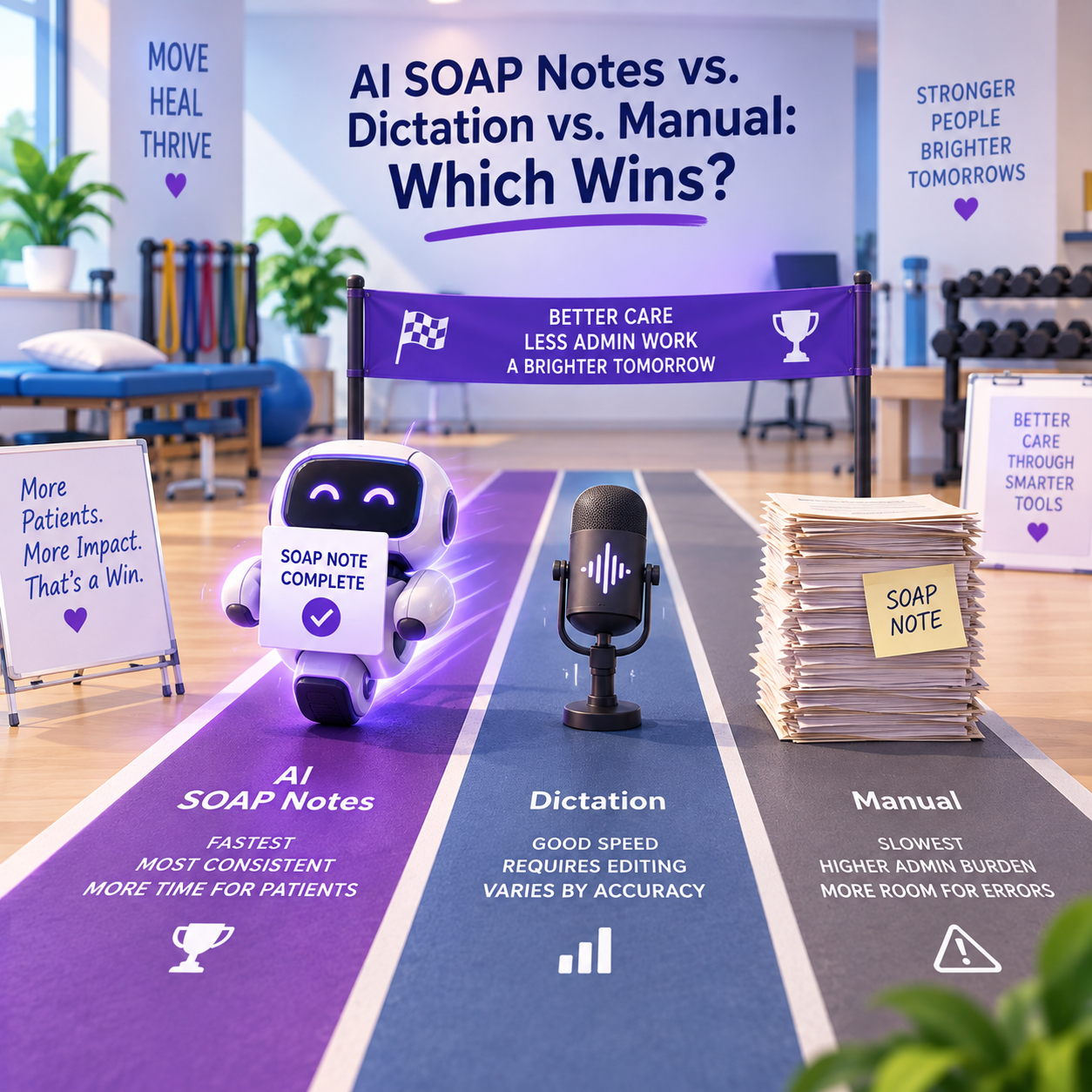
It's 8 PM, and you're still finishing notes from six hours ago. Manual charting is eating your evenings, but dictation drops the range of motion (ROM) values you measured mid-session. Meanwhile, AI tools feel like a compliance risk you can't afford. None of the options feel quite right for you or your practice.
That tension is why AI SOAP notes have become a hot topic in PT, OT, and ST clinics. Most clinicians aren't sure whether these tools meet Medicare and HIPAA requirements.
The good news? When an AI SOAP note generator is purpose-built for rehab therapy and backed by a signed Business Associate Agreement (BAA), it can slash documentation time while keeping your practice compliant. Here's how AI, dictation, and manual charting compare for clinicians where it matters most.
Build a PT SOAP Note That Survives an Audit
Each SOAP section carries specific documentation requirements that affect medical necessity and reimbursement. This guide breaks down what belongs where and why it matters.
AI SOAP notes use ambient recording and natural language processing (NLP) to capture what happens during a therapy session. The tool then organizes that information into Subjective, Objective, Assessment, and Plan (SOAP) sections for you to review and sign. The workflow breaks into three steps:
Now, compare this process to dictation. You would read out the entire session into a recorder after the patient leaves, then review the transcript. Or manual charting, where you would type everything from memory. Both methods put the full authoring burden on you. AI shifts your role from author to editor.
Ambient recording means a microphone listens during the session rather than requiring you to speak into it afterward. It runs in the background while you treat.
The concern is obvious: a rehab gym or speech and language studio sounds nothing like a quiet office. You've got resistance bands snapping, patients on nearby tables, and conversations overlapping. Purpose-built tools are trained on therapy-session audio patterns, so they handle more of that noise than a generic transcription app.
But noisy environments still produce transcription gaps. That's exactly why the review step exists. If the AI's draft is accurate enough to edit rather than rewrite, you save time. If it's not, you're doing double work.
Rehab therapy SOAP notes require documentation elements that generic AI tools aren't built to capture. Those elements include:
We call this the Rehab Therapy SOAP Note Framework. A tool trained on primary care or mental health encounters, rather than rehab-specific elements, will create work for you instead of saving it.
A PT's Objective section isn't a summary of vital signs. Rather, it is goniometric ROM measurements (right knee flexion 95° → 110°), manual muscle test grades, and functional mobility scores like TUG results. It also includes exercise parameters: sets, reps, and resistance levels.
OT adds ADL performance metrics, while ST adds swallow study findings or articulation accuracy percentages. Generic AI tools trained on primary care don't know how to parse these data types from ambient audio. They'll either omit them or drop a ROM value into the Assessment section where it doesn't belong.
The Plan section must include measurable functional goals tied to the patient's plan of care. Simple inputs like "Continue PT" don't cut it. Vague goals don't support medical necessity and won't survive a Medicare audit. The note needs language like "Patient will independently transfer sit-to-stand with no assistive device in 4 weeks."
Beyond language, plan-of-care (POC) documentation also has its own timing requirements. According to the 2025 CMS MLN Fact Sheet, beginning January 1, 2025, a written order or referral may be substituted for the initial plan-of-care signature when the signed POC isn't returned within 30 days.
Your AI tool needs to surface POC certification status and recertification timing. Without that, you risk denials that have nothing to do with the quality of care you delivered. Platforms built for PT, OT, and ST, like Empower EMR, include templates that already account for ROM fields, functional goal formatting, and plan-of-care recertification tracking.
Seeing a list of requirements is one thing. Seeing what a properly structured AI-generated note looks like makes the gap between generic and purpose-built tools clear. Here's a PT session example with ROM measurements, functional goals, and a CPT code reference.
Scenario: 58-year-old patient, post total knee arthroplasty (TKA), 4 weeks post-op, third PT visit. The session included ROM exercises, gait training, and therapeutic exercise.
S (Subjective): Patient reports decreased stiffness in right knee compared to last visit. Rates pain 4/10 during active flexion, down from 6/10. She can now navigate stairs at home using the railing.
O (Objective): Right knee AROM: flexion 95° → 110°, extension −5° → 0°. Left knee WNL. Gait: ambulating 200 ft with single-point cane, reduced lateral trunk lean. TUG: 14.2 seconds (prior: 18.6 seconds). Therapeutic exercise: 3×10 quad sets, 3×10 SAQ, 2×10 step-ups 6" step. Modalities: none this session.
A (Assessment): Patient progressing toward functional goals. ROM gains are consistent with expected post-TKA trajectory. Gait pattern improving; cane still required for community distances. Patient motivated and compliant with HEP.
P (Plan): Continue PT 2×/week for 4 weeks. Progress to 8" step-ups and lateral step-overs next session. Short-term goal: right knee flexion ≥120° within 2 weeks. Long-term goal: independent community ambulation without assistive device by week 8. CPT: 97110 (therapeutic exercise, 2 units), 97116 (gait training, 1 unit). Next POC recertification due: [date].
Notice the elements a generic AI tool would likely miss:
These aren't formatting preferences. They're documentation requirements that affect whether you get reimbursed and whether the note holds up under audit.
AI SOAP notes, dictation, and manual charting each handle rehab therapy documentation differently. The comparison below is based on five dimensions that matter most to PT, OT, and ST clinics:
Every session generates ROM measurements, exercise parameters, and functional test scores. Each method handles them differently. Here's a look at how.
Dimension | AI SOAP Notes | Dictation | |Manual Charting
Time per note | 2–5 min (review + sign) | 5–10 min (narrate + review transcript)
10–20 min (type from memory) | ROM / functional data capture | Auto-parsed from session audio if tool is rehab-specific; generic tools miss it
You must narrate every measurement verbally | You type every value manually | EMR integration
Direct integration with rehab-specific EMRs; note populates chart automatically | Transcript requires copy-paste or manual entry into EMR
Native to EMR but slow | HIPAA compliance risk | Requires BAA with vendor; ambient recording creates protected health information (PHI) exposure if not covered
Lower PHI risk if dictating into EMR directly; higher if using consumer transcription apps | Lowest third-party risk; PHI stays in your EMR | Cost
$99–$300+/mo per provider (varies by platform) | Free if built into EMR ; $10–$50/mo for standalone transcription | No additional cost beyond EMR subscription
Manual charting carries the least compliance risk because PHI never leaves your EMR , but it costs the most time. Dictation splits the difference. You still have to read out structured data like ROM values and test scores out loud. That's awkward mid-session and error-prone when you're recalling numbers after the fact.
AI SOAP notes are the fastest and most structured option, but only when the tool understands rehab-specific data types and is covered by a BAA. Ambient AI tools have been shown to reduce EMR interaction time by about 2 minutes per appointment, according to a 2025 study in JAMA Network Open.
A Business Associate Agreement (BAA) is a legal contract that makes a vendor responsible for protecting your patients' protected health information (PHI). An AI SOAP note tool is HIPAA compliant only when the vendor signs a BAA and backs it with end-to-end encryption, access controls, and audit logging. Without a BAA, any AI tool that touches patient data is a compliance violation, no matter what the marketing page says.
A BAA requires the vendor to safeguard PHI, report breaches within the HIPAA-required timeframe, and allow HHS audits. This isn't a checkbox on a signup form. It's a binding legal document that creates real liability for the vendor.
Before you create an account with any AI SOAP note vendor, ask these four questions:
Vendor security isn't theoretical. In 2024, network-server incidents accounted for 98% of all individuals affected by large PHI breaches, according to the HHS OCR Annual Breach Report. If a vendor can't answer those four questions clearly, that tells you everything you need to know about the security of its network.
Here's a scenario that's more common than it should be: a therapist builds a custom SOAP note template in consumer ChatGPT and pastes session details into it after each visit. The problem? Consumer ChatGPT is not covered by a BAA. Pasting or typing PHI into it is a reportable HIPAA violation, even if you remove the patient's name. Session details, diagnoses, and treatment plans are all PHI.
OpenAI does offer BAA-covered options through API access and ChatGPT for Healthcare. These are enterprise-tier products designed for regulated workspaces. They are not the free or Plus plans most clinicians use. If you're currently using consumer ChatGPT for SOAP notes with real patient data, stop and switch to a BAA-covered platform built for clinical documentation.
Like any note-taking method, AI-generated SOAP notes have the potential to contain errors. A 2025 study published in JMIR found errors in 70% of draft notes. Remember, you're legally responsible for every note you sign. So, a structured review process isn't optional.
Explore where the most common errors pop up, and how to keep an eye out for them.
According to JMIR, omissions are the most common type of error in AI-generated notes. Omissions happen when the AI leaves out a medication, a contraindication, or a key patient statement. Other documented error categories include:
For rehab therapy, omission errors carry the highest risk. If the AI drops a ROM measurement or misses a functional goal update, the note may not support medical necessity for the billed CPT codes. That gap often results in a denial or an audit flag.
Run these five checks before you sign any AI-generated note:
The 2–3 minutes you spend on this checklist protects your license, your reimbursement, and your patient.
See How Empower EMR Handles HIPAA Compliance
Evaluating an AI documentation tool means checking encryption, access controls, and BAA coverage. See exactly how Empower EMR protects patient data at every step.
Explore HIPAA Compliant PT Software
For rehab therapy clinics, AI SOAP notes deliver four measurable benefits:
The benefit clinicians feel first is the drop in "pajama time," the charting you do at home after the clinic closes. A 2025 Penn Medicine study found a 30% decrease in after-hours charting and about 15 minutes of daily personal time reclaimed with AI-powered notes. For a PT clinic running 8–10 sessions per therapist per day, that's the difference between finishing documentation at the clinic and finishing it on your couch—or, worse, not finishing it all together.
Open notes create a follow-on problem that goes beyond work-life balance: they slow your billing cycle. When notes sit open for days, billing backs up. Denials become harder to appeal because the details are no longer fresh. Mass General Brigham found a 66% reduction in delayed note closures when using a hybrid ambient note-taking plus human QA model. Faster note closure means faster claim submission, which means faster reimbursement.
The financial case for AI SOAP notes exceeds time savings, too. A 2026 study in JAMA Network Open found that AI scribe adopters saw +1.81 relative value units (RVUs) per week and 0.80 more encounters per week with no evidence of increased denials. Even one extra encounter per week at average PT reimbursement rates can cover the monthly cost of a healthcare automation tool.
Not to mention, the above Penn Medicine study found a 20% decrease in time spent interacting with the EMR during and after patient encounters. That time goes back to the POC: cueing exercises, observing movement quality, building the therapeutic relationship that drives adherence and outcomes. Where manual charting keeps you in the EMR the longest and dictation requires post-session screen time, AI shifts the balance toward the person on your treatment table.
You now have a framework for evaluating AI SOAP notes, dictation, and manual charting based on the dimensions that matter most to your clinic: time per note, ROM documentation accuracy, HIPAA compliance risk, and cost. With this information, you can choose the method that fits your practice size, specialty requirements, and workflow without putting patient data at risk.
If you're on the market for a reputable, rehab-specific AI SOAP note generator, you've come to the right place.
We built Empower EMR's AI documentation specifically for PT, OT, and ST workflows. It parses ROM measurements, flags plan-of-care recertification deadlines, and integrates directly with your chart, backed by a signed BAA. Your therapists finish notes before the next patient is called, your billing team submits claims faster because notes close on time, and you can prove Medicare compliance with audit-ready documentation, all without adding IT overhead or disrupting your front desk.
See Empower EMR's Documentation Tools Built for PT
AI-assisted templates, built-in outcomes and flowsheet tools, and compliance checks, all inside one HIPAA-compliant platform with encryption, access controls, and auditability. See how your notes close faster without leaving the chart.
Yes, and many PT, OT, and ST clinicians do. The catch is fit: generic tools trained on primary care miss rehab-specific elements like ROM measurements and functional goals, and any tool that touches patient data has to be HIPAA-compliant. Choose one built for rehab therapy and covered by a BAA.
Only when the vendor signs a Business Associate Agreement (BAA) and backs it with encryption, access controls, and breach reporting. Without a BAA, any AI tool that processes patient data is a compliance violation, regardless of marketing claims. Ask for a signed BAA before you create an account.
Technically yes, but consumer ChatGPT (free and Plus) is not HIPAA-compliant, because OpenAI doesn't sign a BAA for those tiers. Entering patient data is a reportable violation even with the name removed. OpenAI's enterprise ChatGPT for Healthcare is BAA-covered, but for clinical use a purpose-built documentation platform is the practical choice.
Five things: ROM and functional values are present and in the right SOAP section, the Subjective section matches what the patient actually said, goals are measurable and tied to the current plan of care, the documented services support the billed CPT codes, and nothing was invented that you didn't discuss or observe.
Clinical studies show AI SOAP note tools reduce EMR interaction time by about 2 minutes per appointment, reclaim approximately 15 minutes of personal time per day by cutting after-hours charting by 30%, and enable clinicians to see +0.80 additional encounters per week without increasing denial rates, according to Penn Medicine and JAMA Network Open. Less time on manual work and more time with clients equals an increase in revenue.