Running a PT practice means making constant decisions about staffing and schedules. New technology adds another choice to the mix. Yet most trend coverage only tells you what's changing in the profession. It rarely explains what those changes mean inside your clinic.
That's the part that matters. Current trends in physical therapy affect everything from technology and care delivery to the way practices build their teams. Each one brings real decisions for owners and managers.
AI-assisted documentation can change how therapists spend their time. Hybrid care can reshape scheduling and patient access. New reporting demands affect documentation. Understanding those effects can help you make better decisions before you're forced to react.
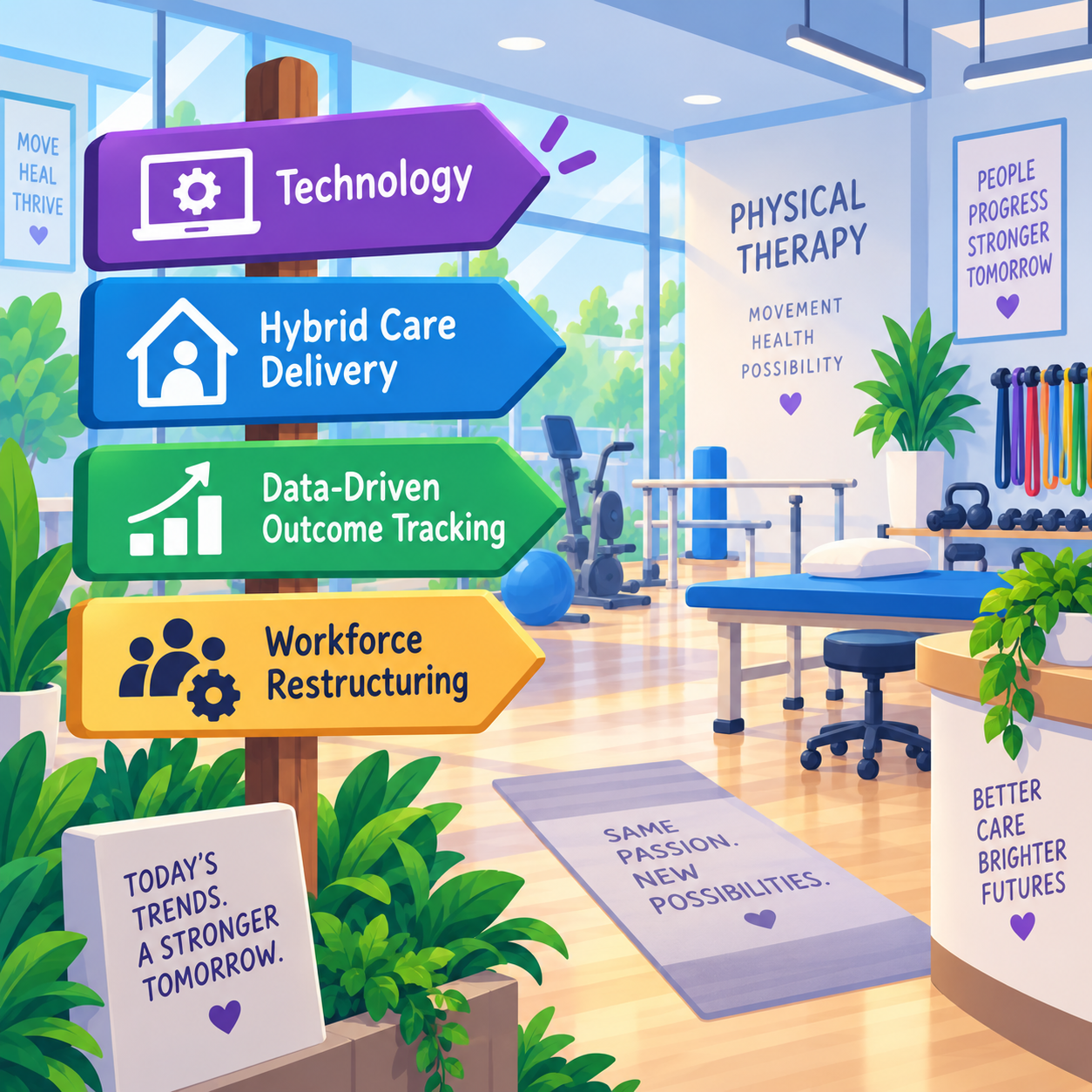
Current trends in physical therapy cluster into four areas:
Each one changes how a practice schedules, documents, bills, or staffs. Knowing the links between them turns reaction into strategy. Yet most trend coverage tells you what's new without tying it to your practice. Let's take a different, more honest approach.
Physical therapy nowadays looks deeply different from the pre-pandemic model. More technology for physical therapy now touches both clinical tools and operational systems. The table below maps each major trend to a plain-language definition. It also outlines the specific effect it creates.
The sections that follow unpack each trend in detail. Technology trends come first. Then care models. Then tracking and workforce pressures.
Four types of technology for physical therapy are reshaping clinic workflows right now:
Each carries a specific patient benefit. Each also has a specific operational result you need to plan for.
Wearable sensors collect movement, adherence, and range-of-motion data outside the clinic. These include accelerometers, goniometers, and motion-capture devices. Many virtual musculoskeletal (MSK) solutions now combine sensors with computer vision. An independent PHTI review found these tools can track adherence and range of motion (ROM). The patient benefit is clear: objective between-visit data replaces self-reported compliance. You get a sharper picture of progress and can adjust plans sooner.
CMS added three new RTM codes for 2026: 98979, 98984, and 98985. All three are designated as "sometimes therapy." CMS also allows PTAs and OTAs to provide certain RTM services under general supervision. RTM creates a billable between-visit workflow. But clinics need clear protocols for device use and treatment-management time. You'll also need a process for documentation and scheduling.
Artificial intelligence in physical therapy currently shows up in three places:
Documentation is the highest-impact use case right now. A JAMA Network Open study of 263 physicians and advanced practice providers found that ambient AI scribes cut clinician burnout from 51.9% to 38.8% after 30 days of use. After-hours documentation dropped by 0.90 hours per clinician per week. The study wasn't PT-specific, but the burden it measured, notes finished outside scheduled hours, is the same burden ambient AI scribes target in a PT setting.
AI documentation tools change how clinicians spend the last 30 minutes of their day. Finishing notes during or right after visits can free up more time in the schedule. Overtime drops. You may even see one more patient per day without adding staff.
Robotics guide high-repetition, steady-intensity movement patterns. These include motorized exoskeletons, gait trainers, and upper-extremity devices. Patients recovering from stroke, spinal cord injury, or complex orthopedic cases benefit most. They get higher repetition volume than manual therapy alone. There's also steady results across sessions.
For most outpatient clinics, robotics requires capital spending. Proper floor space and longer treatment blocks are also necessary. That makes it a referral pathway or a niche investment. The investment makes the most sense when patient volume can support it.
VR and gamification turn repetitive movements into scored, visual tasks during guided rehab. Patients who struggle with motivation during long recovery timelines tend to show higher adherence to HEPs. In-clinic effort stays more steady, too. VR shifts your patient engagement strategy from verbal coaching to structured digital interaction. It may reduce no-shows and drop-offs, but it adds setup time. Staff comfort with the technology matters.
The bottom line? AI documentation and RTM offer the most direct operational payoff for most outpatient practices. Robotics and VR are higher-cost choices that fit specific caseloads and growth plans.
Telehealth in physical therapy is a structurally supported care model. Medicare coverage for PT/OT/SLP extends "from anywhere" through December 31, 2027, per CMS. The real question for practice owners: which visit types belong in a hybrid model? And how do you manage the workflow?
Consult a 2024 systematic review of randomized controlled trials in PubMed. Telerehabilitation shows similar patient satisfaction and similar or better attendance versus in-person PT. This gives you clinical backing to offer hybrid scheduling without expecting more drop-offs.
PT-guided virtual MSK solutions can improve pain and function at a level similar to in-person PT. App-only options help lower-acuity cases but fall short as full substitutes. Telehealth fits best for:
In comparison, these visit types still require in-person care:
You still need consent documentation. You'll also need scheduling templates that split telehealth from in-person slots. Billing workflows must flag the correct place-of-service codes. Not to mention, access friction remains. Commercial payers don't all match Medicare's telehealth rules. Some states still have varying licensure rules for cross-state telehealth.
Hybrid care is a current reimbursement reality with a defined end date. Practices that build scheduling and documentation systems now will be better placed whether the policy extends or not. Empower EMR supports hybrid scheduling and telehealth documentation within one system. You don't need separate workflows for remote and in-person visits.
The care-model shift in physical therapy is moving away from reactive treatment. It's heading toward preventative care and tailored plans. Whole-body wellness is part of this shift. It addresses sleep, stress, nutrition, and recovery habits alongside the musculoskeletal complaint.
The cost of musculoskeletal care helps explain this shift. Consider the 2025 Business Group on Health survey. It found that cancer and musculoskeletal conditions remained the top two cost drivers for large employers. The survey included 125 employers covering 17.1 million people. That pressure puts more focus on long-term results and injury prevention.
These emerging research topics on physical therapy are shaping how clinicians think about episode design. Follow-up protocols expand under this model. Prevention-oriented plans may include:
Home exercise support becomes more critical. Patients managing whole-body wellness need clear, easy-to-reach HEP delivery tools. Your engagement strategy shifts from "complete your visits" to "stay connected between episodes." That ties directly to scheduling, automated reminders, and patient outreach workflows.
Outcome measurement is the standardized tracking of a patient's functional progress from initial evaluation to discharge. It's shifting from a clinical best practice to a formal reporting requirement. This shift affects reimbursement, payer relationships, and practice performance visibility.
First you capture a patient-reported outcome measure (PROM) at the start of care. You capture it again at discharge. Then you calculate the risk-adjusted change in functional status. Picture a patient with a lumbar spine complaint. They complete a standardized functional questionnaire at their initial evaluation. At discharge, they complete it again. The difference, adjusted for age, acuity, and other health conditions, is the measured outcome.
MIPS Quality Measure #217 now requires this risk-adjusted, patient-reported functional status change. It must use a standardized tool such as the FOTO LEPF PROM. Documented outcomes give you data for payer talks and referral-source conversations. They support clinical choices too: if a cohort of patients with a specific diagnosis stalls, the data shows it. Telehealth encounters are allowed.
Outcome reporting shouldn't add to your workload. Empower EMR tracks functional outcomes across episodes of care. PROM capture and reporting become part of the documentation workflow. They're not another separate task. That makes it easier to use outcomes in both patient care and practice decisions.
The national PT workforce shortfall is a current operating condition. It shapes hiring, caseload management, and automation choices. It's also driving growth in specialty niches where demand outpaces supply.
APTA's 2025 workforce forecast paints the picture. Its baseline year, 2022, showed a national shortage of 12,070 full-time equivalent (FTE) physical therapists, a 5.2% shortfall. The forecast projects that gap widening to 8.2% by 2027 before narrowing again in later years. About 72% of surveyed PTs also said they were at or above capacity. Demand isn't slowing down either. The U.S. Bureau of Labor Statistics expects PT employment to grow 11% from 2024 to 2034. That's "much faster than the average" for all jobs.
For clinics, the pressure shows up in daily operations. Open roles can be harder to fill. Existing staff may take on heavier caseloads and more overtime. Patients may also wait longer for appointments. In other words, you can't hire your way out of a national shortfall.
The operational response starts with automation for scheduling, reminders, and documentation. Beyond that, it means scope-of-practice best use that puts PTAs and support staff at the top of their roles. Technology that protects clinician time for direct patient care rounds out the picture. This is why the above technology and hybrid care trends work as capacity strategies.
Three specialty areas are seeing fast-growing demand:
Each niche changes care delivery and documentation. Pelvic floor requires specific intake and consent protocols. Pediatric services involve coordination with schools and families. Sports performance often blends preventative care with cash-pay models.
For practice owners, specialization is both a clinical interest and a business choice. Niches with tight supply and growing demand support stronger margins. They also build distinct referral networks.
Physical therapy is changing on several fronts. New technology is reshaping documentation and care delivery. Outcome reporting is becoming more important. Staffing shortages are putting added pressure on clinic teams. Some of these shifts demand action now. Others can wait. The difference between reacting and choosing is knowing what each trend changes in your daily operations.
We built Empower EMR to help PT practices adapt without adding more work. Every feature protects clinician time. AI tools can reduce hours spent on documentation. Outcomes tracking keeps progress data in the same system. RTM workflows extend care between visits. Specialty intake and consent protocols live in the same chart. No extra software logins. No heavy staff training. No billing friction.
Running a strong practice takes more than keeping up with clinical trends. Visit the Business Resource Hub for more guidance on navigating the business side of PT.
Start with the operational problem you need to solve first. That might be documentation overflow, scheduling gaps, or between-visit engagement. Then match the technology to that friction point. AI documentation and RTM have the fastest payback for most outpatient practices. They address direct capacity and billing workflow pressure. Robotics and VR need larger capital spending. They fit specific caseloads. Treat them as strategic growth choices.
If the December 31, 2027 end date holds, you'll need to shift telehealth slots back to in-person visits. You could also convert them to cash-based virtual care. Commercial payers may keep telehealth coverage even if Medicare sunsets it. Verify your payer mix before making major changes. The workflow systems you've built are reusable regardless of reimbursement policy. Consent protocols, place-of-service tracking, and hybrid scheduling templates all carry forward.
Build PROM capture into your existing evaluation and discharge note templates. It becomes part of the documentation workflow rather than a separate task. Use software that auto-calculates the risk-adjusted change score for MIPS reporting. Choose a standardized tool that meets MIPS Quality Measure #217 requirements, such as the FOTO LEPF PROM. That way you won't need to re-tool later. If your EMR doesn't support native PROM capture and scoring, you'll need a workaround. That adds admin friction.
You're ready if you have three things in place:
Pelvic floor and pediatric services require distinct intake protocols. They also need longer initial evaluations. Coordination with referring providers or schools is part of the workflow. Assess whether your scheduling and billing can absorb that added weight. Specialization works best as a growth strategy when you already have baseline operational efficiency in place.