The 8 minute rule is the Medicare standard for billing timed therapy services: on an outpatient PT, OT, or ST claim to Medicare Part B, you need at least 8 minutes of a timed CPT code to bill one unit, and units are counted in 15-minute increments from your total timed minutes (8 to 22 minutes is 1 unit, 23 to 37 is 2, and up from there).
Knowing the threshold, though, is rarely what trips up a claim. You submitted it, Medicare denied it, and now you're working backward through the math only to find the calculation was right. What failed was a missing modifier or a documentation gap, and that kind of error doesn't surface until after the denial lands.
That's why this guide treats the 8 minute rule as five decisions, not one formula: unit calculation, remainder allocation, telehealth documentation, payer method differences, and PTA/OTA modifier assignment. Get those right and you bill cleanly the first time. This cheat sheet gives you the conversion chart, a five-step workflow, telehealth guidance, and a documentation checklist built on what CMS requires.
Master the Business Side of Physical Therapy Billing
This guide walks through documentation, coding, and compliance fundamentals for therapy clinics, useful when edge cases come up at the point of billing.
Read the Physical Therapy Billing Guide
The 8 minute rule governs timed therapy services on outpatient claims to Medicare Part B, across PT, OT, and ST. It applies whenever you bill a timed CPT code, including same-day sessions that also include an untimed evaluation, and whether the visit happens in person or via telehealth. It does not apply to untimed codes, and many commercial payers use a different method covered later in this guide. Every calculation here rests on one upstream sort: separating your timed codes from your untimed ones. Misfile a single code and every unit total downstream is wrong, so this is the place to be exact.
Timed codes are services billed in 15-minute increments. The total minutes you spend delivering the service set how many units you can charge. Common examples include:
Untimed codes, also called service-based codes, work differently. You bill them once per encounter no matter how long the service takes. Examples include PT and OT evaluations (97161 to 97168), hot/cold packs (97010), mechanical traction (97012), unattended electrical stimulation (97014, or G0283 for Medicare), and group therapy (97150). The 8 minute rule applies only to timed codes. Untimed codes don't factor into your unit calculation at all. Bill them separately on the claim.
Therapy reimbursement has faced repeated pressure, including a 2.83% reduction to the Medicare conversion factor in 2025 (CMS). Every correctly captured unit carries weight on your bottom line, and there's less room to absorb revenue loss from underbilled sessions or reworked claims.
Documentation errors account for a large share of Medicare fee-for-service improper payments, and therapy certification and recertification lapses show up among the top outpatient root causes (CMS). Getting the math right is step one. But the 8 minute rule touches modifiers, payer differences, and documentation requirements. An error at any of those points can trigger a denial or recoupment.
CMS defines exact minute ranges for each billable unit. These thresholds come from the Medicare Claims Processing Manual, Chapter 5 (CMS). Here's the chart your team should reference on every claim.
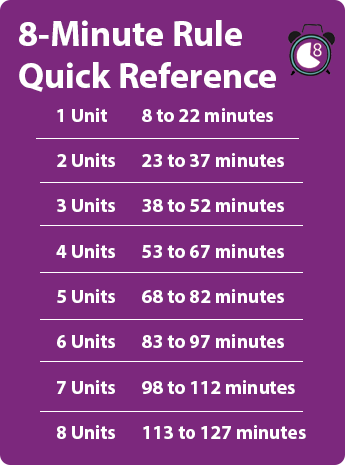
The critical threshold: fewer than 8 minutes of any timed service means zero billable units for that code on its own. CMS doesn't round up. Each added unit requires a full 15 minutes beyond the prior threshold, so moving from 1 unit to 2 means reaching at least 23 total timed minutes.
Two terms help keep this straight. Total direct (timed) minutes is the time spent on timed-code activities only. Total treatment minutes is everything, including untimed services. Only your total timed minutes drive the 8 minute rule calculation.
When a session includes more than one timed code, Medicare doesn't let you round each code on its own. You add the total minutes across all timed services, then allocate units using the combined-remainder method.
Two ways to think about the math get you to the same place:
Start by totaling every timed minute from the session, no matter which CPT code it falls under. That combined number sets your total billable units using the conversion chart. Once you know the total, assign full units first: any code where you provided at least 15 minutes gets its unit. Then assign the remaining units to whichever code has the largest leftover remainder.
Total all timed minutes, find total billable units from the chart, then allocate. Here's how that works with real numbers:
CPT Code | Minutes | Full Unit? | Remainder | Units Assigned
97110 (Therapeutic Exercise) | 20 | Yes (15+) | 5 min | 1
97140 (Manual Therapy) | 12 | No | 12 min | 1
97530 (Therapeutic Activities) | 10 | No | 10 min | 1
Total timed minutes: 42, which falls in the 38-to-52 range, so you can bill 3 units. 97110 earns one unit outright with 20 minutes. That leaves two units to assign by largest remainder: 97140 (12 minutes) takes one and 97530 (10 minutes) takes the other. Final bill: one unit each.
One more rule to know: if any single code has 7 minutes or fewer, it can't be billed as a standalone unit. Those minutes still count toward the combined total. If two short codes together reach 8 or more minutes, you bill one unit for the service with the most minutes.
Occupational therapy. An OT provides 18 minutes of therapeutic activities (97530), 12 minutes of self-care/home management training (97535), and 8 minutes of manual therapy (97140). Total: 38 minutes, which supports 3 units. 97530 earns one full unit, and the remainders (12 and 8 minutes) earn the other two. You bill one unit each.
Speech-language pathology. SLP is the discipline where the timed-versus-untimed distinction matters most. Several core SLP treatment codes, such as 92507 (individual speech, language, and voice treatment), are untimed and billed once per session regardless of length. The 8 minute rule applies only to an SLP's timed services, so confirm which codes in the session are time-based before totaling minutes.
Timed minutes have to reflect skilled, direct, one-on-one care. Get this wrong and the units won't hold up under audit even when the arithmetic is perfect.
Billable time includes hands-on intervention, plus the skilled work around it: assessing the patient's status that day, evaluating their response to treatment, and instructing the patient or caregiver on home program or safer movement. The clock starts when you begin skilled interaction, so observing a patient's gait as you bring them back from the waiting room can count. Documentation done in the patient's presence during the session counts. Documentation completed after the patient leaves does not.
Time that does not count: care provided by an aide (unskilled, and it fails the one-on-one definition), and time spent resting, changing, or waiting for equipment.
Two situations trip clinics up. An initial evaluation is an untimed code, but if you also perform timed interventions that same day, those timed minutes total normally toward units. And the code a service falls under is determined by intent: sit-to-stand for lower-extremity strengthening is therapeutic exercise, while the same movement to improve a patient's ability to rise from a chair is therapeutic activities. Your documentation has to support the code you chose.
Medicare, commercial payers, TRICARE, and Medicaid each apply different remainder logic to timed therapy codes. Billing the same session the same way across all payers is one of the most common sources of denials.
Medicare uses the combined-remainder method covered above: total all timed minutes, then allocate units from that combined total.
Many commercial payers follow the AMA's "Rule of 8s," sometimes called the midpoint rule or Substantial Portion Method. This applies the 8-minute threshold to each CPT code on its own rather than combining remainders across codes (APTA).
This does not automatically mean fewer units. It depends on the session. Where Medicare would combine two short remainders into a single unit, the per-code method gives you nothing for either. But where each code independently clears 8 minutes, the per-code method can yield more units. Example: 10 minutes of 97110 plus 10 minutes of 97140 is 1 unit under Medicare (20 combined minutes) but 2 units under the Rule of 8s (each code clears 8 on its own). Always verify each payer's specific policy. "Commercial" isn't a single rule set.
TRICARE generally pays for therapy services like Medicare where practicable, including timed-code increments, but verify remainder-combining rules in TRICARE manuals before assuming the combined method applies (TRICARE). Medicaid varies by state. Mississippi, for example, bans rounding up when fewer than 8 minutes are provided on 15-minute codes (Mississippi Medicaid). Build payer-specific billing profiles rather than applying one method across all claims.
Payer | Method | Remainder Logic | Key Caveat
Medicare | Combined remainders | Total all timed minutes, allocate units from combined total | Must use CMS conversion chart thresholds
Commercial (many) | Rule of 8s / Substantial Portion Method | Apply 8-minute threshold per code individually | Can yield more or fewer units; verify each payer
TRICARE | Generally follows Medicare | Likely combined, but confirm in TRICARE manuals | "Like Medicare where practicable" language
Medicaid | State-specific | Varies; some states codify 8-minute floors | Check your state's provider manual
PT, OT, and SLP telehealth eligibility under Medicare is extended through December 31, 2027. Timed therapy codes delivered via telehealth follow the same 8 minute rule as in-person sessions. The billing math doesn't change. The documentation and modifier requirements do.
The Consolidated Appropriations Act, 2026, signed February 3, 2026, extended Medicare telehealth flexibilities, including PT, OT, and SLP eligibility as distant-site providers, through December 31, 2027 (HHS; CMS). Patients can be treated in their home with no geographic restrictions, and audio-only delivery is permitted when clinically appropriate. Not every therapy CPT code is eligible for telehealth delivery, so check the current Medicare Telehealth Services List before scheduling remote sessions. This authority is not permanent, so confirm status before late 2027.
The 8 minute rule calculation is the same for telehealth: total your timed minutes, combine remainders, use the same conversion chart. What changes is the claim and the note. Use modifier 95 for audio-video sessions and modifier 93 for audio-only, with place of service 10 when the patient is at home (02 when not). For audio-only sessions, document why video wasn't used or wasn't agreed to. Confirm and record the patient's location. One administrative catch added recently: providers must enroll any home or service address in PECOS before billing telehealth from it.
One point that trips clinics up: the time you document must reflect direct, skilled, one-on-one intervention. Screen time where the therapist is passively watching doesn't count toward timed minutes.
Sometimes a PTA or OTA delivers part of a timed session. When that happens, Medicare applies the CQ (PTA) or CO (OTA) modifier, and payment drops to 85% of the standard rate. There's an exception when the therapist's own minutes meet specific thresholds.
CMS uses a 10% de minimis standard. If the PTA or OTA provides more than 10% of the total minutes for a timed service, the CQ or CO modifier is required on that line, which sets the 85% payment rate. Missing or wrongly applying these modifiers is a denial trigger. The reduction applies per line, not per claim. These pair with the discipline modifiers every therapy claim carries (GP for PT, GO for OT, GN for SLP).
CMS codified a "final-unit" exception that prevents unneeded payment reductions. If the therapist's minutes alone meet or exceed the 8-minute threshold for the final billable unit, that unit bills without the CQ or CO modifier.
Provider | | Code | Minutes | CQ Modifier?
PTA | 97110 | 30 | Yes (PTA delivered majority)
PT | 97110 | 12 | No (PT's 12 min exceeds 8-min threshold for final unit)
The PT's 12 minutes exceed the 8-minute threshold for the final unit, so that unit bills at the full rate. This exception requires precise minute tracking per provider throughout the session.
A repeatable five-step workflow catches the errors that cause denials before claims leave your clinic.
Step 1: Record total timed minutes per code per provider. This starts at the point of care. Therapists log start and stop times for each timed CPT code and note which provider (PT/OT vs. PTA/OTA) delivered each segment. Remainder calculations, modifier decisions, and audit defense all trace back to per-code, per-provider minute logs.
Step 2: Calculate total units using the right method. Apply the combined-remainder method for Medicare claims and the per-code method for commercial payers, based on the payer profile. Cross-reference the conversion chart. Flag any session where total timed minutes fall within 1 to 2 minutes of a unit threshold. Those are your highest-risk calculations.
Step 3: Apply CQ/CO modifiers where required. Run the de minimis test on every line where a PTA or OTA provided treatment, and apply the final-unit exception where the therapist's minutes qualify.
Step 4: Verify payer-specific rules before submission. Confirm whether the payer uses combined or per-code remainders. Check telehealth eligibility if the session was remote. Flag any claim where the payer method would change the unit count from what Medicare would allow.
Step 5: Complete documentation before the claim leaves. The daily treatment note must include total timed minutes, skilled intervention descriptions, and plan-of-care certification status, the elements CMS requires to support payment. Incomplete time documentation is a leading, and entirely preventable, cause of therapy denials and recoupments.
See How Billers Stay Audit-Ready Every Claim
Mixed-provider sessions, modifier logic, and payer-specific remainder methods create real daily pressure for billers. See how Empower EMR supports those checks before claims go out.
Explore Empower EMR for Billers
Missing any one of these gives an auditor grounds to deny the claim or recoup payment after the fact:
Pay close attention to item 3. Therapy certification and recertification timing is a known outpatient root cause of improper payments in CMS data.
Your daily note must support the units you billed. If you billed 3 units, the note needs to show at least 38 total timed minutes across your codes. Auditors cross-reference the total timed minutes in the note against the units on the claim, and a mismatch triggers a request for more documentation or an automatic denial.
Mistake 1: Rounding individual codes instead of combining remainders. The most common Medicare error. Treating each timed code's remainder on its own when submitting to Medicare typically underbills. Total all timed minutes first for Medicare claims.
Mistake 2: Combining timed and untimed minutes. Only timed-code minutes count toward the calculation. Folding hot-pack or evaluation time into the total inflates units and invites denials.
Mistake 3: Applying the wrong method or modifier for the payer. Per-code logic for Medicare underbills. Combined logic for a Rule of 8s payer can misstate units. A CQ/CO modifier applied when the final-unit exception fits leaves revenue on the table, and an omitted modifier when one is required triggers denials.
Mistake 4: Not enough time documentation in the daily note. "Therapeutic exercise x 2 units" without recorded minutes isn't enough. Document start/stop times or total minutes per code per provider in every daily note.
You now have a compliance workflow that covers the five points where billing errors happen: unit calculation, remainders, payer rules, telehealth documentation, and PTA/OTA modifiers. That's the full picture, not just the math formula.
We built Empower EMR to support this workflow on every claim. The platform connects your per-provider minute entries to unit calculations, applies modifier logic and payer-specific remainder methods, and flags sessions where unit counts fall near billing thresholds. Your team spends less time manually checking de minimis thresholds, reconciling which payer uses which remainder method, and matching daily notes against billed units.
See how Empower EMR keeps billing accurate and audit-ready without the manual work.
Stop Reconciling Notes Against Billed Units Manually
Empower EMR turns your therapists' minute entries into clean, audit-ready claims, so your billers spend less time matching notes against units by hand.
Schedule a demo
No, not on its own. Eight minutes is the minimum to bill one unit of a timed code. But those 7 minutes still count toward your combined total, so if another timed code in the same session has leftover minutes, the two together can earn one unit, billed under the code with the most minutes (CMS Medicare Claims Processing Manual, Chapter 5).
Many use the Rule of 8s rather than Medicare's method. The difference is how minutes are counted: the 8 minute rule combines your timed minutes across all codes before counting units, while the Rule of 8s applies the 8-minute threshold to each code on its own. Same session, sometimes different totals. The Rule of 8s gives more units when each code clears 8 minutes individually, and fewer when you would have relied on combined remainders. Verify each payer's method before submitting, since using the wrong one causes underbilling or denials.
The claim will likely be denied or flagged, and if paid initially, recouped during an audit. When a PTA or OTA provides more than 10% of a timed service's minutes, the CQ or CO modifier is required so the 85% reduced rate applies. Fixing it requires resubmitting with the modifier and may require refunding an overpayment.
Document the same elements you would in person, then add the telehealth specifics: the patient's location, the modality, and the matching modifier (95 for audio-video, 93 for audio-only) with place of service 10 for the home. For audio-only, note why video wasn't used. PT, OT, and SLP telehealth is authorized through December 31, 2027 under the Consolidated Appropriations Act, 2026.
When therapists log start and stop times (or total minutes) per provider for each timed code, the platform calculates total units using the combined-remainder method, applies CQ or CO modifiers based on PTA/OTA minutes and the final-unit exception, and flags sessions where unit counts fall near billing thresholds. Automation reduces manual calculation errors, but accurate time documentation at the point of care is still required.