Learn how charting faster can be achieved with templates, tech tools, and smarter workflows.
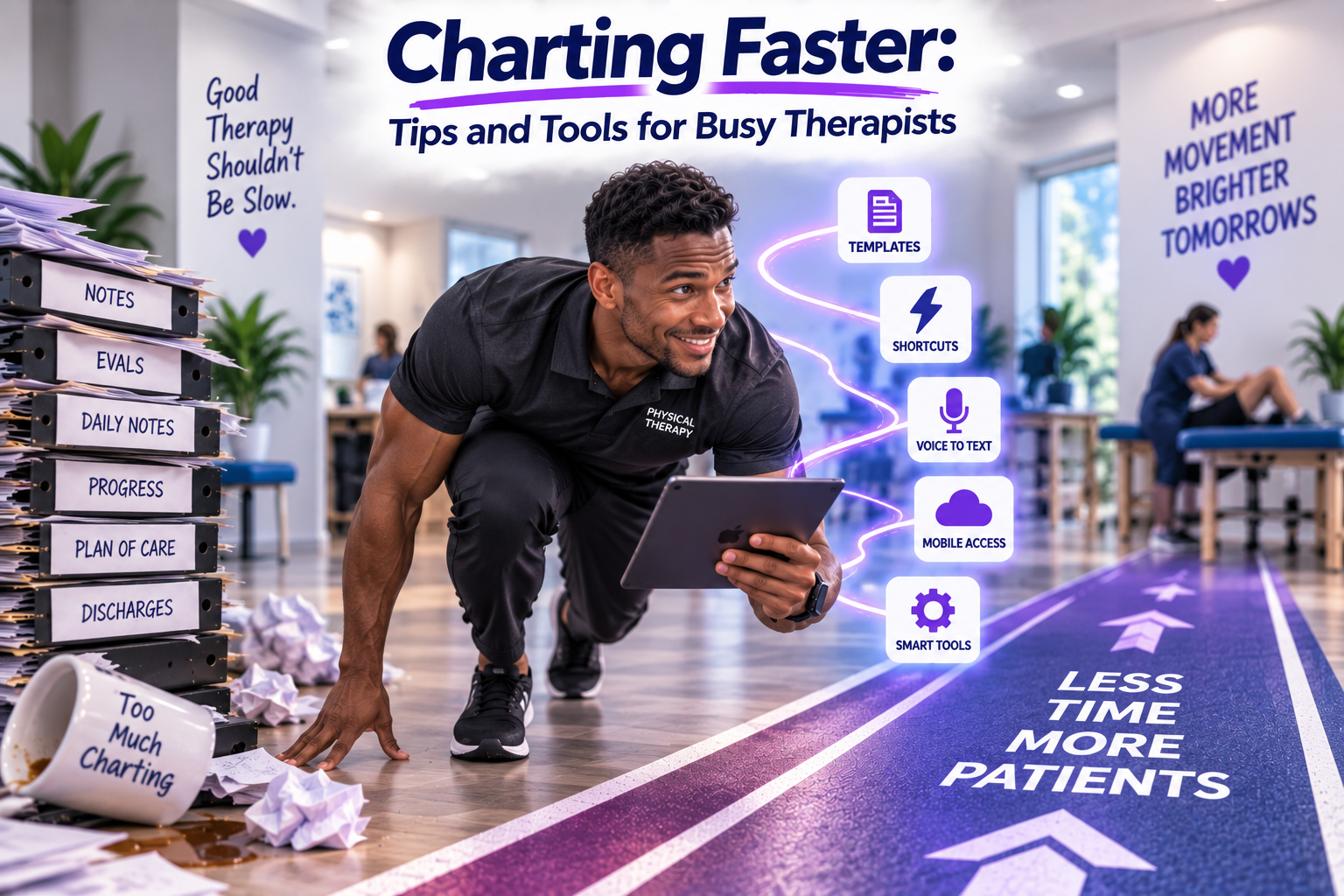
Ever notice how the longest part of your day isn't spent with patients, but catching up on notes? For many therapists, documentation piles up faster than it gets done, making charting feel like a never-ending chore.
But what if you could finish your notes while your memory is fresh and still get home on time? Charting faster is about working smarter, not harder.
Charting faster starts with knowing what slows you down. Many therapists spend too much time on notes because their charting methods are inefficient. Workflows may be unclear, or they may add more detail than needed.
The best way to speed up is to use standard templates and document during or right after each session. Focus only on information that is clinically relevant. Many therapists think more documentation means better care, but that is not true.
Did You Know? Research shows that clinicians spend almost twice as much time on documentation as they do on direct patient care.
Common documentation pitfalls include:
Perfectionism can also slow therapists down. Many spend hours refining notes that are already complete and compliant. Better workflows help you stay compliant while finishing notes during your scheduled hours.
Charting faster begins with understanding what payers actually require.
Get clarity on documentation standards in our Medicare Progress Note Requirements Guide.
You can cut documentation time by changing how you approach charting before and during each session.
Real-time documentation keeps information accurate. Enter key details into your EMR during the session, not hours later.
This reduces missed details and saves time after work. Empower EMR has mobile-friendly tools that make this easy.
Templates eliminate the need to start from scratch with each note. Create standardized formats for evaluations, daily notes, and discharge summaries.
Empower EMR provides customizable templates made for PT clinics.
Not all documentation requires therapist input. Support staff can gather basic information like demographics, medical history, and vital signs.
This delegation strategy allows you to focus on the skilled components of documentation. EMRs with multi-user access allow each person to update their part of the note safely.
Over-documentation wastes valuable time. Focus on clinically relevant information that supports medical necessity and demonstrates skilled care.
Remember the 5 C's to Documentation:
Clear, Complete, Concise, Correct, and Chronological.
These principles help you create efficient, compliant notes.
Brief, factual documentation (including common PT abbreviations) satisfies compliance requirements without unnecessary narrative. This focused approach to documentation speeds up the process while maintaining quality.
Incorporate documentation into your patient interactions. Summarize findings aloud while entering them into your EMR.
This improves accuracy and keeps patients involved. It also reduces the need for changes later.
Physical therapy productivity standards after sessions are crucial for preventing documentation backlogs.
Complete documentation within 5 minutes of each session when possible. This prevents unfinished notes from piling up.
Quick note completion is easier with shortcuts and auto-fill tools. Empower EMR's intuitive design supports rapid note completion while maintaining compliance.
If you can't finish immediately, group similar documentation tasks together. For example, complete all progress notes or discharge summaries in one sitting.
This batching technique reduces mental switching costs and increases efficiency. Organizing your charting workflow by task type helps maintain focus and consistency.
Focus on clear, concise documentation rather than verbose descriptions. Notes need to be accurate and compliant, not literary masterpieces.
Avoid unnecessary rewrites and edits that don't improve clinical value. Completion checklists can help ensure you've included all required elements without excessive detail.
Empower EMR's templates, voice-dictation support, and real-time validation help therapists finish notes faster. These tools eliminate repetitive typing and reduce documentation errors. Explore them in our Documentation Software.
Modern technology offers multiple solutions for accelerating documentation without sacrificing quality.
Voice dictation significantly reduces typing time. Simply speak your notes and watch them appear on screen.
AI tools can help structure notes and suggest common phrases. They can also spot missing details. These tools keep improving and make documentation faster.
Quick Fact: Studies show that speech recognition can complete a note in about five minutes. Typing the same note takes almost nine minutes. This saves clinicians valuable time.
Effective EMR systems offer numerous time-saving features:
Empower EMR integrates these features to streamline workflows and reduce manual entry. The system's intuitive design minimizes clicks and maximizes efficiency.
Well-designed templates give you structure but still allow personalization. They include standard sections for each visit type and can be adjusted for each patient.
These structured formats support consistent documentation while saving significant time.
Digital tools allow patients to complete forms before their appointment. This information transfers directly to their chart, eliminating duplicate data entry.
Patient portals enable secure completion of:
Good documentation habits help prevent burnout and improve job satisfaction. The OHIO rule—Only Handle It Once—encourages you to finish tasks right away instead of returning to them later.
Intentional time management supports efficient charting. Build documentation periods into your schedule rather than hoping to find time between patients.
This structured approach prevents documentation from expanding into personal time. It also improves accuracy by ensuring notes are completed while details remain fresh.
Watch for signs of documentation burnout. These include procrastination, feeling dread when you open your EMR, or working late to finish notes every day.
If you notice these warning signs, consider:
Protecting your time and energy ensures sustainable documentation practices. Efficient methods of charting support both compliance and clinician well-being.
Create efficient formats for recording objective findings. Standardized approaches save time and ensure consistency.
These concise formats communicate essential clinical information, like functional measures, without excessive verbiage.
Efficient goal documentation updates only what has changed. It does not require rewriting the entire goal.
Inefficient Approach
Writing entirely new goals each visit
Creating lengthy narrative goal statements
Documenting goals separately from objective measures
Efficient Approach
Carrying forward and updating only changed elements
Using measurable, concise goal formats
Linking goals directly to objective findings
Ready to reclaim hours each week and reduce after-hours documentation? Schedule a Personalized Demo. See how Empower EMR helps therapists chart faster while staying compliant and accurate.
Faster documentation comes from good habits, the right tools, and a focus on what matters most. These changes make charting quicker and less stressful.
Empower EMR supports these habits with simple workflows and smart templates. The platform helps therapists stay efficient, finish notes sooner, and stay compliant.
Ready to make documentation easier? See how Empower EMR streamlines charting and gives you more time for patient care. Schedule a personalized demo.
You can chart faster by documenting in real time, using templates, and focusing only on clinically important details. These steps reduce extra work and save time.
The golden rule is to document only what is necessary and relevant. Keep notes clear, concise, and compliant.
The 5 C’s are Clear, Concise, Complete, Correct, and Chronological. These help you create efficient and compliant notes.