Your therapists finish notes at home. Billing denials drain revenue you can't track down. The front desk is drowning in calls. Patients drop out halfway through treatment. No one knows which problem to fix first.
Most PT clinics face these same issues. But hospital workflow advice doesn't work for outpatient therapy. Your patient journey is different. It runs from scheduling through evaluation, treatment, and billing.
Clinical workflow optimization for PT clinics isn't about general advice. It's about finding the five bottlenecks that create extra work, lost revenue, and patient drop-offs. Then you fix them with the right tools and processes. The result: therapists get their time back, and patients stick with their full treatment plan.
Nearly every outpatient therapy practice struggles with the same handful of problems. These have nothing to do with the hospital or pharmacy examples in most workflow guides. A clinical workflow in healthcare looks very different when your patient journey spans online booking, evaluation, ongoing treatment, home exercise delivery, and billing. Each handoff between those steps is a place where time leaks, errors creep in, and patients fall through the cracks.
Here are the five workflow bottlenecks that hit PT clinics hardest:
When these five issues go unaddressed, they grow across every patient visit. The result is lost hours, lost revenue, and lost patients. No generic hospital playbook will solve these problems for your practice.
Better workflow in healthcare requires more than a single fix. Practices that actually get back time and revenue apply four connected strategies:
Each one targets the PT-specific bottlenecks outlined above.
When every therapist documents differently, billing errors and compliance gaps grow with your clinic. Different intake routines at the front desk make it worse. Standardization removes that variation so your team follows the same playbook no matter who's working.
Process changes fail when staff view them as extra work instead of a more efficient workflow. Train your team on why the new process saves time, not just how to use it.
For example, front-desk staff may continue manually calling payers after electronic eligibility verification goes live, which reduces the expected time savings. Standardizing the automated workflow helps prevent old habits from replacing the new process.
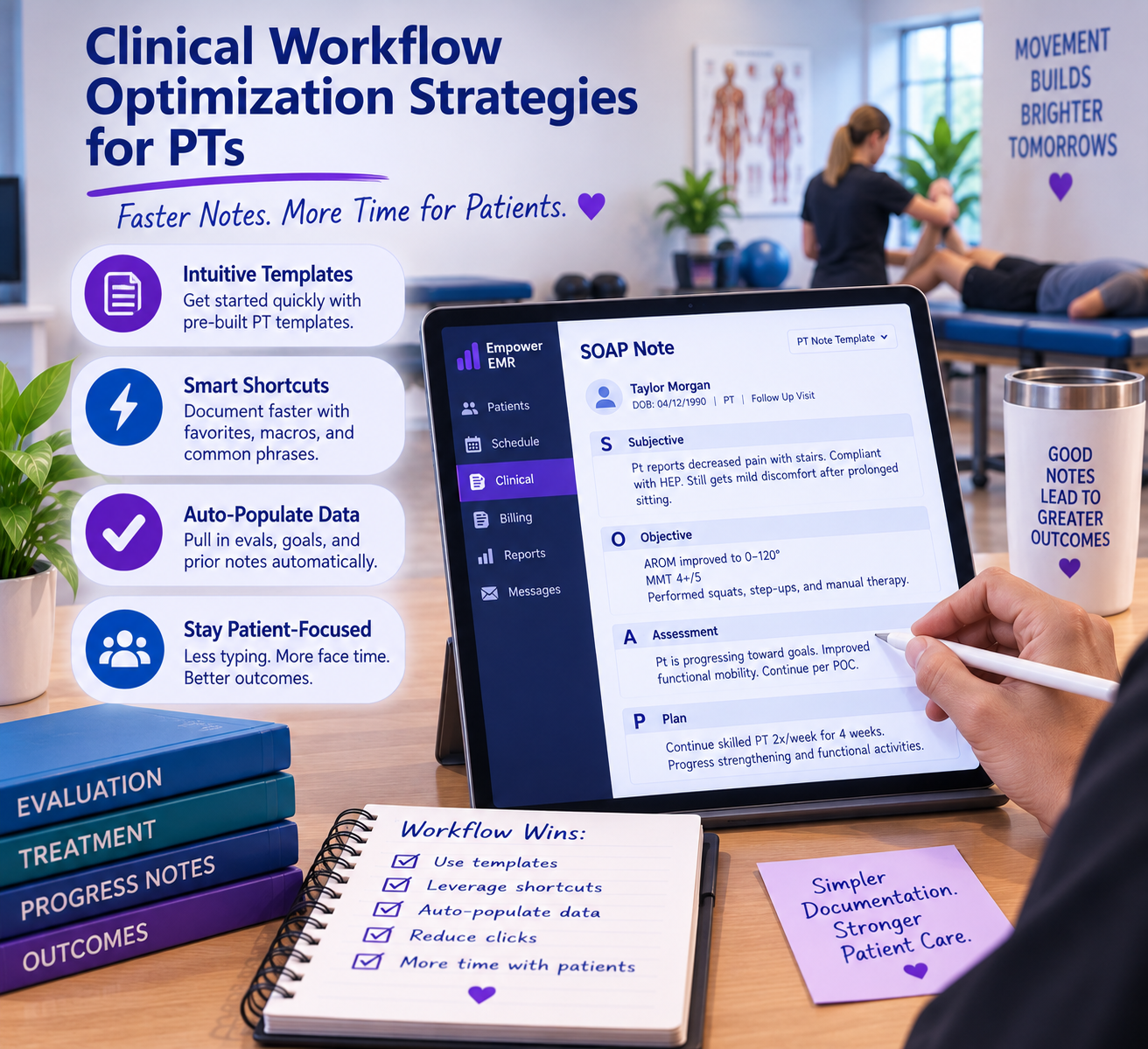
The best healthcare technology for therapy practices isn't another tool bolted onto your stack. It's automation that replaces manual steps already buried in your clinical workflow. Ambient AI documentation is a clear example. The system listens to your patient conversation during the session, then auto-generates a structured SOAP note (Subjective, Objective, Assessment, Plan). The therapist reviews and approves the draft rather than typing from scratch. A 2024–2025 Mayo Clinic study in Digital Health (SAGE) found an 18.6% drop in time-in-notes per encounter. That kind of cut matters when therapists chart ten or more visits a day.
The table below shows which manual steps automation can replace:
Healthcare workflow management breaks down the moment your systems stop talking to each other. Many PT clinics run two or three disconnected platforms without seeing how much friction that mix creates. If any of these red flags sound familiar, your tools are working against you:
These disconnected systems create data silos. Patient information sits fragmented across platforms that don't talk to each other. Your scheduler can't see if a therapist finished the note. When staff toggle between systems to piece together what should be a single patient record, every handoff introduces delays and errors.
True all-in-one integration means scheduling, documentation, and billing draw from the same data in real time. Platforms built for outpatient therapy—like Empower EMR—connect those workflows as built-in features so nothing slips between the cracks.
Better clinical workflow isn't purely an internal effort. Patient-facing tools do two things at once. They lighten staff workload and keep patients engaged through their full plan of care. All patient-facing tools—digital check-in, portal access, home exercise program (HEP) delivery—must be HIPAA-compliant to protect patient health information. That improves the overall patient experience on both sides of the front desk.
On their own, each strategy addresses a different bottleneck. Inside a single connected platform, they reinforce each other. Standardized processes feed clean data into automated billing, and digital tools keep patients engaged through every step of their plan of care.
A broken clinical workflow doesn't just feel slow. It carries a price tag you can calculate for your own practice. Start with documentation. If a therapist averages 20 minutes per note and treats 10 patients a day, that's over three hours of charting daily. Much of it happens after the last patient leaves. That pattern drives clinician burnout and pushes therapists to leave practices. As noted above, ambient AI tools showed they can cut nearly 19% off note time. That means roughly 35 minutes saved per therapist on a 10-patient day.
Revenue losses from denials and no-shows make the problem worse. National denial rates sit at about 12%. Nearly half of those denials trace back to front-end issues like registration errors and eligibility gaps, per the Optum 2024 Denials Index. For a clinic billing $100 per visit with 200 weekly visits, a 12% denial rate risks $1,200 per week. Many of those claims are never recovered.
Layer on two to three no-shows per day at that same visit value. You're looking at another $1,000 to $1,500 in weekly revenue that simply vanishes. A clinical workflow management solution built for therapy practices tackles all three cost drivers—documentation time, billing accuracy, and patient retention—from one platform.
These aren't abstract numbers. They're the hours your therapists lose every night, the dollars your billing team can't recover, and the patients who quietly stop showing up before their plan of care is done.
Better workflows start with four steps: standard processes, automation, connected systems, and tools patients can use themselves.
Empower EMR connects scheduling, documentation, and billing in one platform built for PT clinics. Therapists finish notes before the next patient arrives. Claims go out with no extra data entry. The front desk gets fewer phone calls because patients book and check in online.
The payoff? You recover revenue from denials that never happen. Your team gets back the hours they used to spend on manual work.
See how Empower EMR eliminates workflow bottlenecks and gives therapists their time back. Schedule a demo.
Start with the bottleneck that touches the most patient visits. That's usually eligibility verification or documentation time. Track one week of front-desk eligibility checks and therapist charting hours. Then pick the friction point where automation delivers fast gains. For example, switching to real-time electronic verification saves about 12 minutes per check, per the CAQH Index.
Use PT-specific SOAP note templates with pre-filled fields and smart defaults. Train therapists to finish notes right away after each visit instead of batching at day's end. Templates cut repeated typing and enforce required documentation for compliance. Finishing notes between patients prevents the three-plus-hour evening backlog that drives burnout.
You can standardize processes and add patient-facing tools. But you'll still lose time to double data entry and billing errors until scheduling, documentation, and claims live in one system. Workaround gains are real but limited. Templates and reminders help, yet charges won't flow from notes to billing without integration. Platforms built for PT clinics like Empower EMR connect these workflows as built-in features. That removes the manual handoff that creates coding errors and claim delays.